CE marking of pressure equipment
You can affix the CE mark and sign the declaration of conformity without worries.
Willy Lebherz
Director & founder of easyCE GmbH


Declaration of conformity done!
Receive your CE declaration of conformity ready for signature.
Risk assessment completed!
CE mandatory risk analysis conducted.
Relevant directives & standards applied!
Your product evaluated against relevant directives and standards.
Technical documentation created!
Receive a pragmatic, user-friendly operating manual.
CE mark attached!
Simply affix the CE mark and you're done.
CE marking routines differ depending on your role
CE AS PRODUCER
The Pressure Equipment Directive (PED), Directive 2014/68/EU, governs the entry of pressure equipment into the EU market. It applies to new or used equipment, regardless of origin, aiming to ensure safety and free movement. Covered products include vessels, pipelines, safety devices, and assemblies with a maximum pressure exceeding 0.5 bar. The directive prohibits Member States from impeding compliant equipment use. Examples of covered products are storage tanks, industrial pipelines, heat exchangers, boilers, and safety devices.
The experts at easyCE will be happy to help you place your products on the market and assess special cases. We are happy to support you with CE, UKCA and other labelling.

FAQ
What is the Pressure Equipment Directive?
The original Pressure Equipment Directive 97/23/EC was replaced in 2006 by Directive 2014/68/EU on pressure equipment (PED). This Directive applies to pressure equipment and its components and assemblies
that are new to the EU market, whether new or used, manufactured in the EU or imported from a third country. For the purposes of this article, the term "manufacturer" includes agents and importers.
What is the aim of the Pressure Equipment Directive?
The aim of the Directive is to ensure the free movement of stationary pressure equipment within the EU while guaranteeing a high level of safety. For this reason, the Directive states that Member States
do not prohibit the provision or use of equipment, components or assemblies complying with this Directive under the conditions specified by the manufacturer for reasons of pressure hazards restrict or hinder.
Which products are covered by the Pressure Equipment Directive?
"Pressure equipment" means vessels, pipelines, safety devices and pressure-bearing equipment with a maximum permissible pressure PS of more than 0.5 bar. It also includes elements attached to pressurized components such as flanges,
nozzles, couplings, brackets or lifting eyes. Assemblies are defined as multiple pressure equipment assembled by a manufacturer into an integrated and functional whole. Products covered by the Directive include the following:
- storage tanks under pressure, industrial pipelines,
- heat exchangers,
- Jacket and water tube boilers
- boiler
- steam generators
- safety devices
- printing supplies
How does the Pressure Equipment Directive relate to national legislation?
In particular, the Directive does not affect the power of Member States to lay down requirements necessary to ensure the protection of persons, in particular workers, when using pressure equipment, components or assemblies unless this means changes to those devices in a manner not provided for in this Directive.
When do I have to comply with the Pressure Equipment Directive?
The Directive applies to the design, manufacture and conformity assessment of pressure equipment, components and assemblies.
Which products are excluded from the directive?
The policy contains a long list of exceptions that are listed below:
- pipelines or a piping system designed to transport fluids or substances to or from a plant (on land or at sea), starting with and including the last shut-off device within the plant including all associated equipment specifically designed for piping; this exclusion does not apply to standard pressure equipment found in pressure reduction or compressor stations
- networks for the supply, distribution and discharge of water, as well as the associated equipment and pressure lines such as pressure pipelines, pressure tunnels, pressure shafts for hydropower plants and the corresponding specific accessories
- simple pressure vessels covered by Directive 2014/29/EU
- aerosol dispensers covered by Council Directive 75/324/EEC (14)
- equipment intended for the operation of vehicles defined in the following acts:
- Directive 2007/46/EC
- Regulation (EU) No 167/2013
- Regulation (EU) No 168/2013
- Devices that are not higher than category I of this Directive and fall under one of the following directives:
- (i) Directive 2006/42/EC
- (ii) Directive 2014/33/EU
- (iii) Directive 2014/35/EU
- (iv) Directive 93/42/EEC
- (v) Directive 2009/142/EC
- (vi) Directive 2014/34/EU
- devices covered by Article 346 paragraph 1 letter b TFEU
- Articles specially designed for use in the nuclear field and whose failure can lead to the release of radioactivity
- Borehole control equipment used in petroleum, natural gas or geothermal exploration and production, and underground storage, which is used to contain and/or control borehole pressure, including the drill head (Christmas Tree)blow-out devices (BOP), pipe distributors and all upstream equipment
- devices comprising housings or machines where the design, choice of material and manufacturing requirements are based primarily on the requirements for sufficient strength, rigidity and stability, in order to meet the static and dynamic operating conditions or other operating characteristics, and where pressure is not an essential design factor; these devices may include:
- i. engines, including turbines and internal combustion engines
- ii. Steam engines, gas/steam turbines, turbogenerators, compressors, pumps and actuators
- blast furnaces, including the furnace cooling system, hot-wind recuperators, dedusting plants and blast furnace exhaust scrubbers, and direct reduction cupola furnaces, including furnace cooling, gas converters and furnaces for melting, remelting, degassing and casting steel, iron and non-ferrous metals
- Enclosures for high voltage electrical equipment such as switchgear, control units, transformers and rotating machinery;
- Pressure pipes for enclosing transmission equipment, such as power and telephone cables
- ships, rockets, aircraft and mobile offshore units, as well as equipment specifically designed for installation on board or propulsion thereof
- pressure equipment consisting of a flexible sleeve, such as tires, air cushions, game balls, inflatable boats and other similar pressure equipment
- Exhaust and intake silencers
- bottles or cans for carbonated drinks for final consumption
- containers for the transport and distribution of beverages with a maximum PS-V of 500 bar and a maximum permissible pressure of not more than 7 bar
- equipment covered by Directive 2008/68/EC and Directive 2010/35/EU, and equipment covered by the International Code for the Carriage of Dangerous Goods by Seagoing Vessels or the Convention on International Civil Aviation
- radiators and pipes in hot water heating systems
- Container for holding liquids with a gas pressure above the liquid not exceeding 0,5 bar
Is the Pressure Equipment Directive applicable to my industrial plant?
The Pressure Equipment Directive applies only to components and subassemblies. It does not apply to pressure equipment assembled on site under the supervision and responsibility of the user, as is the case with industrial equipment.
What are the requirements of the Pressure Equipment Directive for my product?
The Printer Equipment Directive specifies pressure and/or volume thresholds; pressure equipment and assemblies above these must:
- be sure
- meet the essential safety requirements for design, manufacture and testing
- comply with appropriate conformity assessment procedures
- bear the CE marking and any other information
Pressure equipment and assemblies below the specified pressure/volume thresholds must:
- be sure
- be designed and manufactured in accordance with the recognised technical rules of a Member State
- bear the required markings (but not the CE marking)
What does the CE mark mean?
The CE marking indicates that a product sold in the European Economic Area complies with health, safety and environmental protection standards. It must be applied to any product covered
by the directives before it can be placed on the market. Benefit from the years of CE experience of our experts at easyCE and let us advise you intensively about your product. easyCE even takes care of creating central CE documents for you.
How do I prove that my product is CE compliant?
In order to apply the CE marking on a product, a technical dossier must be drawn up that proves that the product meets all requirements. The manufacturer is solely responsible for declaring compliance with all requirements. Once a product is CE marked, dealers or importers can request the technical documentation with all accompanying documents.
How is compliance with the directive ensured?
It is the responsibility of the manufacturer to ensure compliance with the directive and good engineering practice of a Member State in the design and manufacture of a product.
Pressure equipment that falls within the scope of the Directive and exceeds the above-mentioned thresholds must be CE-compliant, before it can be placed on the market in the EEA (EU, Iceland, Liechtenstein and Norway). You have already prepared the documents, but are not sure whether the conformity is sufficiently proven? easyCE also offers a review.
How does my product become CE compliant?
In addition to the Pressure Equipment Directive, there are other laws and regulations that may apply to your product or assembly. for example Regulation (EC) No 765/2008, Decision No 768/2008/EC or Directive 97/23/EC. It is the responsibility of the manufacturer to ensure that all relevant regulations are complied with. easyCE researches requirements for your specific product.
What does Regulation (EC) No 765/2008 say?
Regulation (EC) No. 765/2008 establishes the rules for the accreditation of conformity assessment bodies, provides a framework for the market surveillance of products and for controls on products from third countries and lays down the general principles of CE marking.
What innovations does the IVDR bring regarding the general safety and performance principles (SPR)?
The extended version of the Basic Requirements is now referred to as the General Safety and Performance Principles or Requirements (SPR). The SPR/GSPR under the IVDR cover many aspects to be considered and are listed in Annex 1 to the Directive. easyCE can support you in the preparation of the necessary documentation.
What does Decision 768/2008/EC say about pressure equipment?
Decision No 768/2008/EC lays down common principles and model provisions to apply to all sectoral legislation. Directive 97/23/EC should therefore be adapted to that Decision.
How are Directive 97/23/EC and Regulation No 1272/2008 related?
In Directive 97/23/EC, pressure equipment is divided into hazard categories. This also includes the classification of the liquid contained in the pressure equipment as dangerous or not dangerous.
By Regulation (EC) No. 1272/2008, in order to implement the globally harmonised system for the classification and labelling of chemicals, new hazard classes and categories are introduced which only partially comply with the provisions of Directive 67/548/EEC. Directive 97/23/EC should therefore be based on Regulation (EC) No. 1272/2008 to be harmonised, maintaining the level of protection provided for in the Directive.
How do I make my printing device safe?
The basic safety requirements of the Pressure Equipment Directive include specifications for the design and manufacture of pressure equipment, such as:
- Procedures for permanent joints (usually welding procedures), where approval is granted by the notified body
- Qualification of welders and NDT personnel; approval is granted by the notified body
- Materials: here the notified body evaluates - if applicable - the respective material evaluations
- Assessment of the quality management system of material manufacturers by the notified body
- Assessment of pressure equipment by the notified body, including design review, final evaluation and pressure testing
What are the specific requirements for my product?
If there is a harmonized standard applicable to the specific product and the production process complies with this standard, the product is considered compliant with the overarching directive. easyCE is happy to advise you on the applicable standards
How do I verify the conformity of my product?
Pressure equipment is divided into different categories in the Pressure Equipment Directive. These range from I to IV, according to the danger levels in ascending order.
Pressure equipment shall be subject to the conformity assessment procedure selected by the manufacturer from the available procedures of the category in which they are classified. The manufacturer can also choose a process of a higher category if available. A product may require either a self-assessment or the involvement of a notified body.
What is a notifying authority?
Member States shall designate a notifying authority for the establishment and implementation of the necessary procedures for the assessment and notification of conformity assessment bodies
and for the monitoring of notified bodies of recognised independent bodies and operator verifiers. The notifying authority shall identify and designate notified bodies to perform the necessary tasks for a manufacturer.
When is a notified body involved?
The use of a notified body is mandatory for devices of category II or higher. For pressure equipment of categories II, III and IV, the operating procedures and personnel shall be approved by a competent third party.
This shall be a notified body or a third organisation recognised by a Member State, at the discretion of the manufacturer. In order to issue those authorisations, the notified body or the third party shall have carried out investigations and tests in accordance with the relevant harmonised standards or equivalent investigations and tests.
What tests are required?
"If the risks posed by the printing equipment or assembly necessitate monitoring, the manufacturer must conduct tests on samples of that equipment or assembly. easyCE can assist you in determining whether this is necessary.
The manufacturer must also maintain a complaint register and recall non-compliant devices. Additionally, the manufacturer should inform dealers of any irregularities."
How does a test program work as a method for experimental design?
The design of the device may be fully or partially validated by an appropriate test program performed on a sample representative of the device or device category. The test programme shall be clearly defined prior to the test
and shall be accepted by the notified body responsible for the design conformity assessment module, if any. This programme shall lay down the test conditions and the criteria for acceptance or rejection. The actual values of the essential dimensions and characteristics of the materials of which the tested equipment consists shall be measured before the test. Where appropriate, the critical areas of the pressure equipment must be observed during the tests with appropriate instruments that detect strains and stresses with sufficient accuracy.
What role does a notified body play in the assessment and verification process?
Certain conformity assessment procedures require each part to be inspected and tested by a notified body or operator verifier for acceptance of the pressure equipment or the assembly. In other cases, arrangements should be made to ensure that the final assessment can be monitored by a notified body through unannounced visits.
The manufacturer shall provide the notified body with access to the manufacturing, acceptance, testing and storage facilities and provide it with all the necessary documentation, including the quality assurance system, technical documentation and quality reports such as test reports, test data, calibration data, reports on the qualifications of employees in this area.
The notified body shall conduct regular audits to ensure that the manufacturer maintains and applies the quality assurance system and shall provide it with an audit report. The minimum frequency of periodic audits shall be a full reassessment every three years.
In addition, the notified body may make unannounced visits to the manufacturer. The need and frequency of additional visits shall be determined on the basis of a visit control system operated by the notified body. The visit control system should take into account in particular the following factors: the category of pressure equipment, the results of previous monitoring visits, the need to follow up on corrective actions, where appropriate, specific conditions relating to the approval of the system, as well as significant changes in the manufacturing organisation, policy or techniques. During these visits, the notified body may carry out product tests to verify the proper functioning of the quality assurance system. The notified body shall provide the manufacturer with a report of the visit and, if tests have been carried out, a test report.
Can you object to a notified body's decision?
Decisions by a notified body or a third-party organisation and an operator verifier may be appealed. Member States have set up opposition procedures against these decisions.
What are the evaluation procedures for category I products?
For category I products, the manufacturer carries out the conformity assessment and its documentation. easyCE is happy to support you with the provision of documents or a review of your documents.
How do I perform the conformity check?
The conformity assessment is carried out in six steps:
- Define device type
- Determine gas or liquid
- Select the fluid group
- Select Conformity Assessment Chart
- Select hazard category from the table
- Determine the conformity assessment module
How to define the device type?
There are six types of printing equipment:
- Vessel: A housing designed and constructed to accommodate pressurized fluids, including its direct attachments to the junction with other equipment. A container can consist of more than one chamber.
- Steam generator, pressure cooker or other heated pressure equipment: Fired or otherwise heated pressure equipment designed to produce steam or superheated water at a temperature of more than 110°C and with a volume of more than two liters. This includes all pressure cookers.
- Piping: Piping components for transporting liquids when connected to a pressure system for integration. Pipelines include pipes or pipe systems, hoses, fittings, expansion joints, hoses or other pressure-bearing components. Heat exchangers, which consist of pipes for cooling or heating air, should also be considered pipelines.
- Safety accessories: These accessories include direct pressure relief devices, such as safety valves and rupture discs, as well as limiting devices. Limiting devices can either activate the means for correction or provide for a shutdown or shutdown and locking, such as pressure switches and temperature switches.
- Pressure accessories: devices with an operating function and a pressure-bearing housing, for example valves, pressure regulators, pressure gauges, filters.
- Assemblies: Assemblies are multiple pressure equipment that are assembled by a manufacturer into an integrated and functional whole. Examples of assemblies are distillation units, evaporation units and filter systems.
How do I determine whether there is gas or liquid?
If the vapour pressure of the liquid at the maximum permissible temperature is more than 0.5 bar above the normal atmospheric pressure, it shall be treated as a gas. Where a container or chamber contains more than one liquid, the classification shall be based on the liquid required by the higher hazard category.
How do I select a conformity assessment chart?
Select the corresponding conformity assessment diagram according to the lower row of the following overview table:
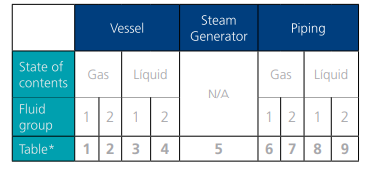
How can I read the hazard category from the conformity assessment diagram?
To determine the hazard category, use the maximum permissible pressure (bar) and volume (liter or nominal diameter (DN)). The boundary lines in the charts indicate the limits of each category.
Safety accessories are classified in category IV. However, exceptionally, a safety accessory manufactured for a particular device can be classified in the same category as the device that protects it. A pressurized piece of equipment is classified either as a pipe (by its volume) or as a container (by its diameter). If the printing accessory has both specifications (volume and diameter), the category with the higher value shall be applied. Assemblies are classified according to the higher category of pressure equipment (excluding the equipment with safety function).
Which conformity assessment modules are available?
Pressure equipment is subject to the conformity assessment procedure/module, which you select from the Available in the classified category. The categories have the following module selections:
- Category I: Module A
- Category II: Modules A2, D1, E1,
- Category III: Modules B(D) + F, B(P) + C2, B(D) + D, B(P) + E, H
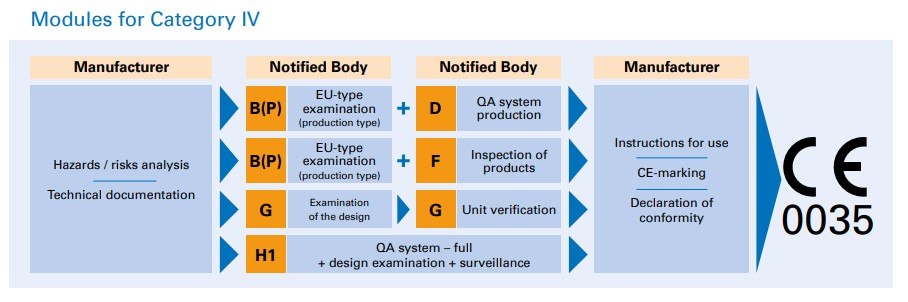
- Category IV: Modules G, B(P) + F, B(P) + D, H1
You can also choose a procedure of a higher category.
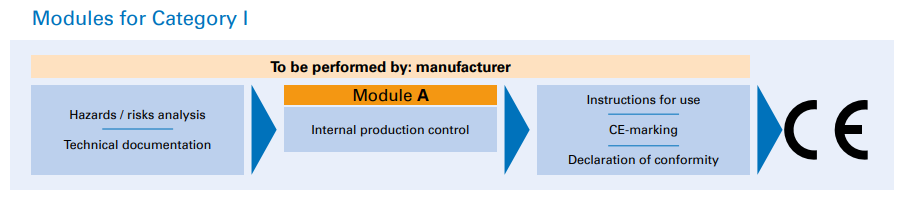
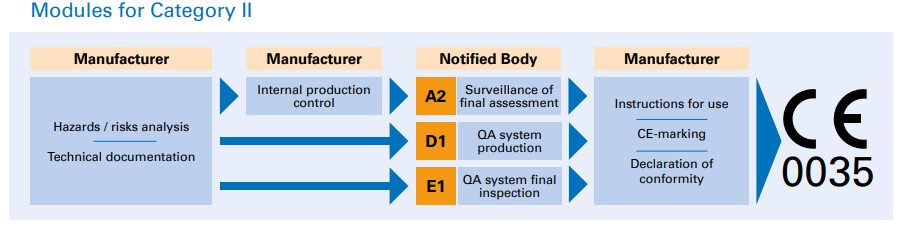
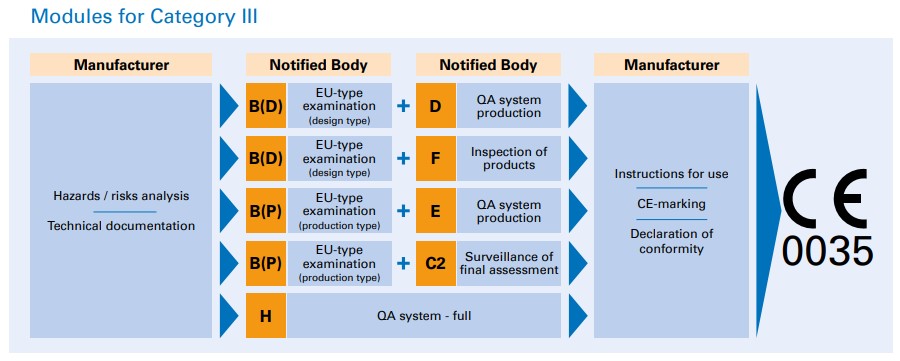
What are Modules A and A2?
Internal production control - In module A, the manufacturer is responsible for the ongoing internal production control. For module A2, random pressure equipment tests must be carried out in addition to the internal production control.
What is Module B(P)?
EU type examination (production type) - The aim of this type of examination is for the notified body to determine whether the requirements of the PED are met on the basis of an inspection of the technical documentation and a production sample.
What is Module B(D)?
EU Type Examination (Design Model) - Unlike the EU Type Examination, the design type examination is performed only on the basis of the technical documentation, without a type or product test being performed.
What is Module C2?
Conformity with the type - If the manufacturer declares that the pressure equipment complies with the type (type) described in the EU type-examination certificate, the notified body only randomly monitors the manufacture and testing at the manufacturer's plant.
What are the modules F and G?
Unit verification - In addition to type testing and QA modules, the PED also requires individual testing to assess compliance with the Pressure Equipment Directive. During the individual test,
each product must be tested by an independent body. The notified body shall review the technical documentation and carry out the final assessment. Upon completion of the test, the notified body shall issue the certificate of conformity. This is the basis for the issuing of the declaration of conformity and for the CE marking by the manufacturer.
What are the modules D, D1, E, E1, H, H1?
QA systems - In addition to conventional product testing, the PED also requires the introduction of a QA system and its evaluation by a notified body. The requirements of the PED for the QA system
are based on the current requirements of the certification according to DIN EN ISO 9001, supplemented by product-specific requirements, which result from the provisions of Annexes I and III of the PED.
What should be considered in the EU type examination - production samples?
This is the part of a conformity assessment procedure in which a notified body examines and verifies the technical design of the pressure equipment and certifies that it meets the requirements of this Directive. The manufacturer shall submit an application for EU type-examination to a notified body of his choice.
How does the notified body's verification programme work?
The notified body may request further samples if this is necessary to carry out the verification programme, as well as proof of the appropriateness of the technical design solution.
Such evidence should include all documents used when the relevant harmonised standards have not been fully applied. Where necessary, the additional evidence should include the results of tests carried out by the manufacturer's corresponding laboratory using other relevant technical specifications.
The manufacturer shall grant the notified body access to the manufacturing, acceptance, testing and storage facilities and shall provide it with all the necessary documentation.
All pressure equipment shall be individually tested, subject to appropriate tests as provided for in the relevant harmonised standards or equivalent tests, in order to ensure its conformity with the approved and in the EUtype-examination certificate of the type described and with the corresponding requirements of this Directive. In the absence of such a harmonised standard, the notified body shall decide on the appropriate tests to be carried out.
How do I issue the declaration of conformity?
The declaration of conformity must contain the following information:
- the name and full business address of the manufacturer or of the representative authorized to issue the declaration;
- An identification number; this number may be the serial number, product or batch number, model or type;
- A statement stating that the exhibition is under the sole responsibility of the manufacturer;
- A description of the pressure equipment or assembly and the conformity assessment procedure applied; for assemblies, a description of the assembly and the conformity assessment procedures applied to it;
- A declaration that the declaration complies with the relevant harmonisation legislation;
- references to the relevant harmonised standards used in or referred to in the technical specifications;
- the name, address and identification number of the notified body that carried out the conformity assessment procedure;
- the identity and signature of the authorised person; and
- The date the declaration was made.
easyCE is happy to prepare a declaration of conformity for you. After all necessary steps have been taken to ensure conformity, the CE marking must be affixed to the product.
How is the CE marking applied to the product?
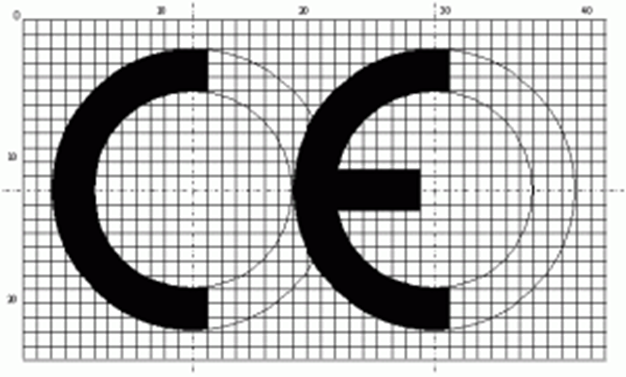
The CE mark consists of the letter CE and must have the form shown below. The letters must be of the same size and must not fall below a height of 5 millimeters. The proportions must be adhered to, even if the size is changed.
The CE marking must be clearly visible, legible and permanently affixed to the product or its type plate. If this is not possible or not guaranteed due to the nature of the product, it must be affixed to the packaging (if available) and accompanying documents.
Who is responsible for compliance with the Pressure Equipment Directive?
The responsibility for compliance with the requirements of the directive lies solely with the manufacturer.
What are the obligations of the importer of pressure equipment?
Importers must ensure that the products they place on the market comply with the applicable requirements and do not pose a risk to the public. The importer must ensure that the manufacturer has taken the necessary steps outside the EU and that the documentation is available on request.
The importer should indicate on the printing equipment or assembly his name, his registered trade name or his registered trade mark and his postal address where he can be reached
An importer should be available to the competent authorities if further information or documentation is needed. In addition, he must keep a copy of the EU declaration of conformity for 10 years from the time the product is placed on the market so that the authorities can verify it.
What are the obligations of a pressure equipment dealer?
The Distributor shall exercise due care to ensure that its handling of the pressure equipment or assembly does not adversely affect the conformity of the product. The Distributor shall ensure that the Product is accompanied by the required documentation, instructions and safety information in a language that is easily understood by consumers and others.
What are the obligations of other economic operators?
An economic operator placing a pressure equipment or assembly on the market under its own name or trademark or modifying a pressure equipment or assembly in such a way as to affect compliance with the requirements of this Directive should assume the obligations of the manufacturer.
What are the consequences of non-compliance with the Pressure Equipment Directive?
Each Member State is obliged to impose sanctions on manufacturers, importers and traders who do not comply with the Pressure Equipment Directive. It is therefore necessary to refer to the legislation on product safety in each State. In Germany, for example, the following penalties are provided for violations of the Product Safety Act:
- fines ranging from €3,000 to €30,000 (full 19) and
- Imprisonment of up to 1 year (§ 20).
Hundreds of companies trust easyCE














With easyCE, product compliance is really 'easy'
Approach to CE marking
Type and manner of support
Scope of support
Contact during project processing

 Find the easiest way to obtain the CE mark
Abbreviated process for CE derived directly from CE
All-inclusive or modular – whatever you prefer
Personal contact with experts who take your wishes into account
other CE service providers
 Often lacking in sound judgement and unnecessarily complicated
Mostly flexible but often bureaucratic
Mostly flexible in terms of support scope
Mostly personal contact
CE Software
Follows standardised process; special circumstances not taken into account
Double burden for you: software management + no support during processing
Only according to software scope and purchased modules
No contact
You want support that lightens your workload and doesn't create more work.

This is what successful projects look like
CE marking and conformity assessment of all life phases of a copper mining tunnel boring machine in Australia
easyCE supports the entire conformity assessment process including risk assessment up to the declaration of conformity ready for signature for all phases of the life cycle of a tunnelling machine for copper mining in Australia. The completely new concept of using multi-arm cutting heads required special attention during the process. In addition to the conventional regulations, special safety and technical requirements that apply in Australia were also taken into account.
RL & VO: MRL - 2006/30/EU, EMC - 2014/30/EU, Low voltage - 2014/35/EU, PED - 2014/68/EU, ATEX - 2014/34/EU
CE labelling of switch cabinets
easyCE supports the entire conformity assessment process, including risk assessment, right through to the declaration of conformity for control cabinets ready for signature. In particular, the requirements from the Machinery, EMC and Low Voltage Directives with regard to DIN EN 60204-1: 2019-06 and DIN EN IEC 61439-1: 2021-10 had to be observed. A checklist was also drawn up for the selection of components that must fulfil special requirements (supplier selection).

CE marking and declaration of conformity of a mobile satellite communication system
easyCE supports the entire conformity assessment procedure, including risk assessment in accordance with the EMC Directive, right up to the ready-to-sign declaration of conformity for a satellite communication system. The system ensures the redundant forwarding of TCP/IP data in order to send or receive it via two or more satellite antennas. The system is used wherever a mobile communication system needs to be set up quickly over long distances.
RL & VO: RED - 2014/53/EU, Low Voltage - 2014/35/EU, EMC - 2014/30/EU
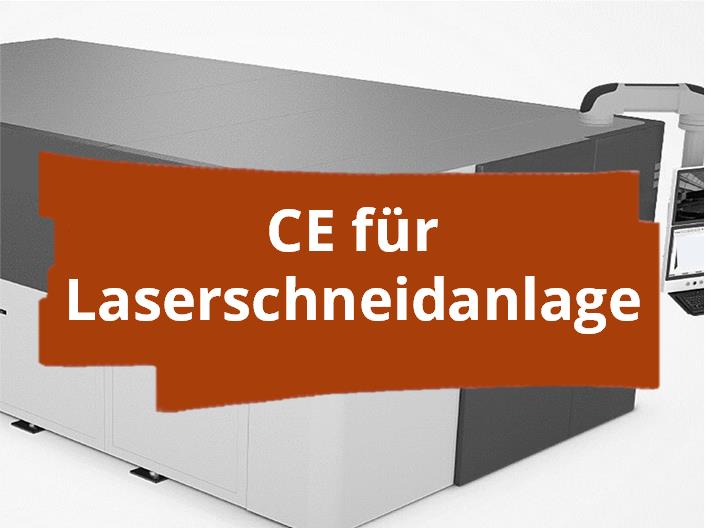
CE marking and declaration of conformity for a 2D laser cutting system
easyCE supports the entire conformity assessment procedure for a 2D laser cutting system with automatic pallet changer. The entire safety concept, including the 2-beam light barrier, was coordinated for the laser cutting system, the performance level was determined, a product analysis was created and a risk assessment was carried out in accordance with EN ISO 12100. Special requirements result for the mechanical components of the traverse for the laser cutting head, but especially for the kinematics of the pallet changer and laser cutting head. The cutting process (laser class 4) inside the cabin is safely shielded from the operator by laser protection screens, additional safety devices and the complete enclosure: laser class 1 outside the machine.
Takes into account among others: 2006/42/EC, 2014/30/EU, DIN EN 60825-1 etc.
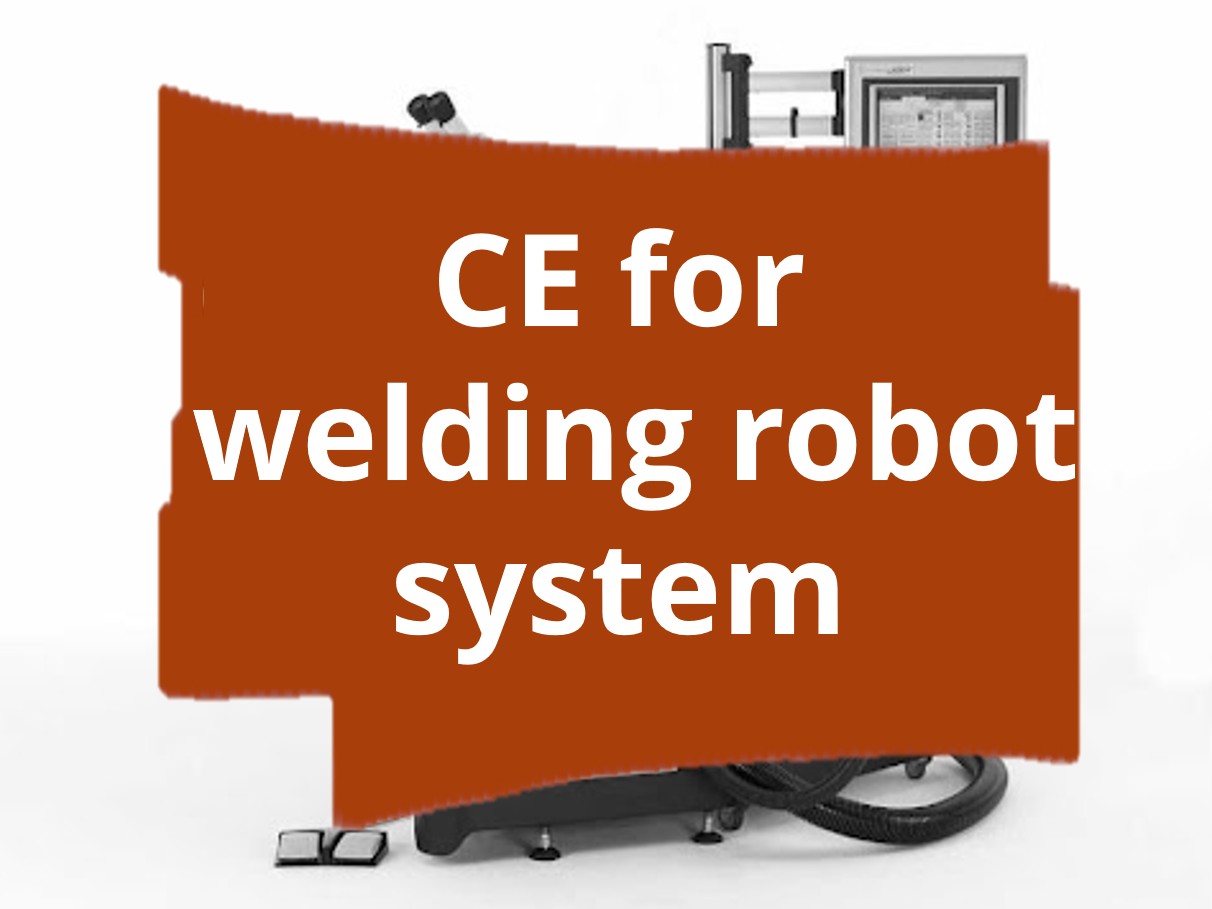
Conformity assessment procedure and CE marking for automated welding robot system
easyCE successfully supports CE marking through to the ready-to-sign Declaration of Conformity for an automated welding robot system with two robot arms on a rail track. The particular challenge was integrating safety procedures for the dual welding technologies (arc stud and MAG welding) while complying with EN 60204-1 for electrical equipment. By applying EN ISO 14119:2013 for interlocking devices, a reliable safety concept with door interlocking was implemented, guaranteeing optimal personnel protection with high system availability.
Considering: 2006/42/EG, 2014/30/EU
See more of our project references and success stories
Get CE-marking done in 3 simple steps
Step 1
Request expert opinion
Ask for our expert opinion free of charge and find out what is necessary for the CE marking of your product. Be prepared to describe your product in broad terms.
Step 2
Receive our offer
If your product is subject to CE marking, we offer you our support with the CE marking and all accompanying measures. We will be happy to explain necessary steps on the phone.
Step 3
We get it done
When you place an order, you will be assigned your own personal CE expert who will carry out your CE marking and accompany you throughout the entire process. Your expert will also be at your side after the CE marking has been successfully completed.
Get CE-marking done, worry-free
Trust the experts of product safety and conformity

Willy Lebherz - Founder and Managing Director of easyCE
- Expert in product safety and conformity since 1995
- Recipient of the "Medal of the Order of Merit of the Federal Republic of Germany", awarded in 1983 by the then Federal President Carl Carstens
- Master of measurement and control technology
- Captain (ret.), Project Officer for Technical Logistics in the Army Material Office and Chief of the Telecommunications Repair Company
easyCE is a digital, dynamic engineering office with a focus on product safety and product conformity - especially CE-marking. We support manufacturers, operators and dealers in designing products safely and offering them on the market in compliance. We are a "full-service provider" and can take over the entire conformity assessment process for you if you wish. To do this, we support you in carrying out risk assessments, researching standards, product analyses, developing suitable safety precautions, preparing user-friendly technical documentation, coordinating tests and all other accompanying measures. easyCE was founded in southern Germany, but is now active globally.
We know what you need to do to get CE-marking done, worry-free.