The Sport Boat Directive (RCD)
You can affix the CE mark and sign the declaration of conformity without worries.
Willy Lebherz
Director & founder of easyCE GmbH


Declaration of conformity done!
Receive your CE declaration of conformity ready for signature.
Risk assessment completed!
CE mandatory risk analysis conducted.
Relevant directives & standards applied!
Your product evaluated against relevant directives and standards.
Technical documentation created!
Receive a pragmatic, user-friendly operating manual.
CE mark attached!
Simply affix the CE mark and you're done.
CE marking routines differ depending on your role
CE AS PRODUCER
Directive 2013/53/EU on pleasure craft and watercraft came into force in 2014 and required transposition into national law by 2016; the RCD applies to boats with 2.5-24 meters hull length, regardless of propulsion. Pleasure craft manufactured since June 1998 must meet the RCD safety requirements, while certain vehicles are exempt from this, such as those built in the EEA before June 1998 or used only for tourism purposes. Responsibility for compliance lies with the first-time distributor, the CE marking and documentation such as the Technical Design Dossier (TCF) and a user manual.
Find out here what the requirements of the EU Directive 2011/65/EU are and how this can influence the CE marking of your product.
The experts at easyCE will be happy to assist you in placing your product on the market in the EEA and in assessing special cases. We support you with CE, UKCA and other markings.

FAQ
Which directive applies to pleasure craft?
The Directive 2013/53/EU on pleasure craft and waterbikes, which repealed Directive 94/25/EC, entered into force on 17 January 2014 and was amended on 23 November 2015. The Member States of the European Economic Area
had two years until 18 January 2016 to transpose the Directive into national law. For manufacturers, there was a one-year transition period to make changes to their designs. The Directive 2013/53/EU is also referred to as the RCD (Recreational Craft Directive). In addition, Implementing Regulation 2017/1 on RCD lays down the labelling.
What is the Sport Boat Directive (RCD)?
The Directive on pleasure craft (RCD) regulates the placing on the market of pleasure craft in the European Economic Area (EEA). It applies to all sports boats with a hull length between 2.5 and 24 meters, regardless of the type of propulsion. Most vessels manufactured for sport and leisure purposes since 16 June 1998 must meet the RCD safety requirements in order to be put into operation on the EEA market or in the EEA.
Which vessels must comply with the RCD?
1. vessels first placed on the EEA market after 16 June 1998
2. were put into operation in the EEA after 16 June 1998 (whether manufactured in the EEA or imported from outside the EEA)
3. a self-made boat placed on the market within five years of completion
4. imported from a third country without CE marking
5. a major conversion of a watercraft (for example, a test or racing boat checked for compliance with the RCD)
Which vessels do NOT have to comply with the RCD?
1. vessels built in the EEA before 16 June 1998
2. used in the EEA before 16 June 1998
3. travelling to the EEA only for tourist purposes or in transit (the periods are not fixed)
4. vessels intended exclusively for racing
5. canoes, kayaks, gondolas and pedal boats
6. surfboards and sailing boards
7. historical replicas
8. submarines,
9. hovercrafts and hydrofoils
10. vessels intended for a crew and the transport of passengers for commercial purposes (these are covered by another Directive)
11. vessels built for use by the manufacturer, provided that they are subsequently not placed on the market for at least five years
12. external combustion and steam-driven vessels operated by coal, coke, wood, oil or gas
13. amphibious vehicles, that is, a motor vehicle on wheels or tracks that can drive both on the water and on solid ground
Who is responsible for compliance with the sport boat regulations?
The organization or person placing the vessel on the market for the first time (EEA) is responsible for compliance. Commissioning is the same as placing on the market. A watercraft imported into the EEA must be CE marked by the importer.
What are the obligations of the builder/manufacturer of sports boats?
1. Complete a Technical Design Dossier (TCF) for each model or family of vessels.
2. Create a user manual in the language of the country where the watercraft is marketed.
3. Present a written declaration of conformity.
4. Mark the vessel with a CE mark (usually on the nameplate)
The manufacturer shall comply with these requirements even when using a self-assessment module.
What administrative requirements does the RCD place on pleasure craft?
The RCD contains both administrative and protective requirements. The administrative requirements are that the vessel bear the CE mark and that the manufacturer creates a technical information file. For complete vessels or hulls, this dossier shall include test reports or calculations showing that the vessel is sufficiently stable under the expected sea conditions. The manufacturer must also complete a declaration of conformity.
The RCD shall also establish the requirements for self-certification by the manufacturer of the vessel or for the type of testing by a notified body and/or quality control procedures. These are listed in a number of "modules" and depend on the size of the vessel, the sea conditions under which it is to be used and whether one of the relevant harmonized standards has been applied in the construction of the vessel.
What are the RCD protection requirements for pleasure craft?
The guidelines set out the essential requirements in detail. They are based on the conditions for which the vessel was designed.
There are a total of 30 different categories for security requirements. These include requirements for labelling, stability, fire protection, gas equipment, engine protection and many other elements. Some are already subject to harmonized standards, others are in preparation.
How does the conformity assessment work?
Depending on the hull length, the boats are divided into categories. The following procedures are required for category A, B, C and D vessels as set out in Section 1 of Annex I.
What is the conformity assessment procedure for category A and B boats?
For vessels with a hull length of less than 12 m: internal production control with tests (Module Aa) in accordance with Annex VI. For vessels with a hull length of 12 m to 24 m: the EC type-examination (module B) according to Annex VII, supplemented by module C (conformity with the design) according to Annex VIII, or one of the following modules: B + D, or B + F, or G or H.
What is the conformity assessment procedure for category C boats?
For boats from 2.5 m to 12 m hull length:
If the harmonized standards of Sections 3.2 and 3.3 of Annex I are complied with: internal production control (Module A) in accordance with Annex V,
In the event of non-compliance with the harmonized standards set out in Sections 3.2 and 3.3 of Annex I, internal production control with tests (Module Aa) set out in Annex VI.
For boats from 12 m to 24 m hull length:
The EC type-examination (module B) according to Annex VII, followed by module C (conformity with the design) according to Annex VIII, or one of the following modules: B + D, or B + F, or G or H.
What is the conformity assessment procedure for category D boats?
For boats from 2.5 m to 24 m hull length: Internal production control (module A) according to Annex V. For the components referred to in Annex II, use one of the following module groups: B + C, or B + D, or B + F, or G or H.
Is the involvement of a notified body necessary?
The Commission shall publish in the Official Journal of the European Communities a list of notified bodies with the identification numbers assigned to them and the tasks for which they have been designated. The manufacturer may select and commission a notified body to assist and supervise the manufacture and CE marking of the vessel.
Is an inspection of my sports boat required?
The notified body may require a module A test, one or more production watercraft tests and one or more additional tests in accordance with Annex VI. The notified body shall issue a test report containing the test results after all tests have been completed.
What are the consequences of a violation of the RCD?
Failure to comply with the requirements of the RCD Directive or to submit the relevant documents to the customs and/or market surveillance authorities may lead to the exclusion of the watercraft, engine or component from the EU internal market. Pay particular attention to presence
- of the identification number
- the user manual
- the construction board
What is the WIN identification number?
All RCD-compliant vessels are marked with a Craft Identification Number (WIN) (formerly Craft Identification Number (CIN) and before that Hull Identification Number (HIN)). The WIN contains
- the country code of the manufacturer
- the unique manufacturer code assigned by the national authority of the Member State
- the unique serial number
- month and year of manufacture
- the model year
What must an RCD-compliant user manual contain?
Each RCD-compliant watercraft must be supplied with an instruction manual/user manual. The operating instructions shall contain all the information necessary for the safe use of the product, with particular regard to configuration, maintenance, regular operation, prevention and risk management.
What is the construction board of sport boats?
On all RCD-compliant vessels, a manufacturer's sign, also called type plate or construction board, must be clearly visible, readable and permanently attached. This nameplate contains:
- CE marking
- name and contact address of the manufacturer
- the category design
- the maximum load recommended by the manufacturer
- the number of persons the vessel will carry during the voyage
What should be considered in a subsequent evaluation of pleasure craft?
In a subsequent assessment, the contact details of the notified body which carried out the conformity assessment and the words "subsequent assessment" shall be provided instead of the manufacturer's information.
Hundreds of companies trust easyCE














With easyCE, product compliance is really 'easy'
Approach to CE marking
Type and manner of support
Scope of support
Contact during project processing

 Find the easiest way to obtain the CE mark
Abbreviated process for CE derived directly from CE
All-inclusive or modular – whatever you prefer
Personal contact with experts who take your wishes into account
other CE service providers
 Often lacking in sound judgement and unnecessarily complicated
Mostly flexible but often bureaucratic
Mostly flexible in terms of support scope
Mostly personal contact
CE Software
Follows standardised process; special circumstances not taken into account
Double burden for you: software management + no support during processing
Only according to software scope and purchased modules
No contact
You want support that lightens your workload and doesn't create more work.

This is what successful projects look like

CE marking and conformity assessment of all life phases of a copper mining tunnel boring machine in Australia
easyCE supports the entire conformity assessment process including risk assessment up to the declaration of conformity ready for signature for all phases of the life cycle of a tunnelling machine for copper mining in Australia. The completely new concept of using multi-arm cutting heads required special attention during the process. In addition to the conventional regulations, special safety and technical requirements that apply in Australia were also taken into account.
RL & VO: MRL - 2006/30/EU, EMC - 2014/30/EU, Low voltage - 2014/35/EU, PED - 2014/68/EU, ATEX - 2014/34/EU

CE labelling of switch cabinets
easyCE supports the entire conformity assessment process, including risk assessment, right through to the declaration of conformity for control cabinets ready for signature. In particular, the requirements from the Machinery, EMC and Low Voltage Directives with regard to DIN EN 60204-1: 2019-06 and DIN EN IEC 61439-1: 2021-10 had to be observed. A checklist was also drawn up for the selection of components that must fulfil special requirements (supplier selection).

CE marking and declaration of conformity of a mobile satellite communication system
easyCE supports the entire conformity assessment procedure, including risk assessment in accordance with the EMC Directive, right up to the ready-to-sign declaration of conformity for a satellite communication system. The system ensures the redundant forwarding of TCP/IP data in order to send or receive it via two or more satellite antennas. The system is used wherever a mobile communication system needs to be set up quickly over long distances.
RL & VO: RED - 2014/53/EU, Low Voltage - 2014/35/EU, EMC - 2014/30/EU
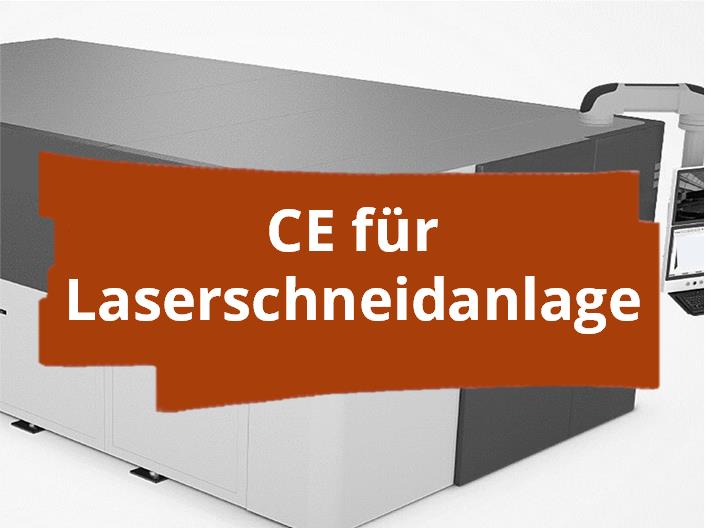
CE marking and declaration of conformity for a 2D laser cutting system
easyCE supports the entire conformity assessment procedure for a 2D laser cutting system with automatic pallet changer. The entire safety concept, including the 2-beam light barrier, was coordinated for the laser cutting system, the performance level was determined, a product analysis was created and a risk assessment was carried out in accordance with EN ISO 12100. Special requirements result for the mechanical components of the traverse for the laser cutting head, but especially for the kinematics of the pallet changer and laser cutting head. The cutting process (laser class 4) inside the cabin is safely shielded from the operator by laser protection screens, additional safety devices and the complete enclosure: laser class 1 outside the machine.
Takes into account among others: 2006/42/EC, 2014/30/EU, DIN EN 60825-1 etc.
See more of our project references and success stories
Get CE-marking done in 3 simple steps
Step 1
Request expert opinion
Ask for our expert opinion free of charge and find out what is necessary for the CE marking of your product. Be prepared to describe your product in broad terms.
Step 2
Receive our offer
If your product is subject to CE marking, we offer you our support with the CE marking and all accompanying measures. We will be happy to explain necessary steps on the phone.
Step 3
We get it done
When you place an order, you will be assigned your own personal CE expert who will carry out your CE marking and accompany you throughout the entire process. Your expert will also be at your side after the CE marking has been successfully completed.
Get CE-marking done, worry-free
Trust the experts of product safety and conformity

Willy Lebherz - Founder and Managing Director of easyCE
- Expert in product safety and conformity since 1995
- Recipient of the "Medal of the Order of Merit of the Federal Republic of Germany", awarded in 1983 by the then Federal President Carl Carstens
- Master of measurement and control technology
- Captain (ret.), Project Officer for Technical Logistics in the Army Material Office and Chief of the Telecommunications Repair Company
easyCE is a digital, dynamic engineering office with a focus on product safety and product conformity - especially CE-marking. We support manufacturers, operators and dealers in designing products safely and offering them on the market in compliance. We are a "full-service provider" and can take over the entire conformity assessment process for you if you wish. To do this, we support you in carrying out risk assessments, researching standards, product analyses, developing suitable safety precautions, preparing user-friendly technical documentation, coordinating tests and all other accompanying measures. easyCE was founded in southern Germany, but is now active globally.
We know what you need to do to get CE-marking done, worry-free.